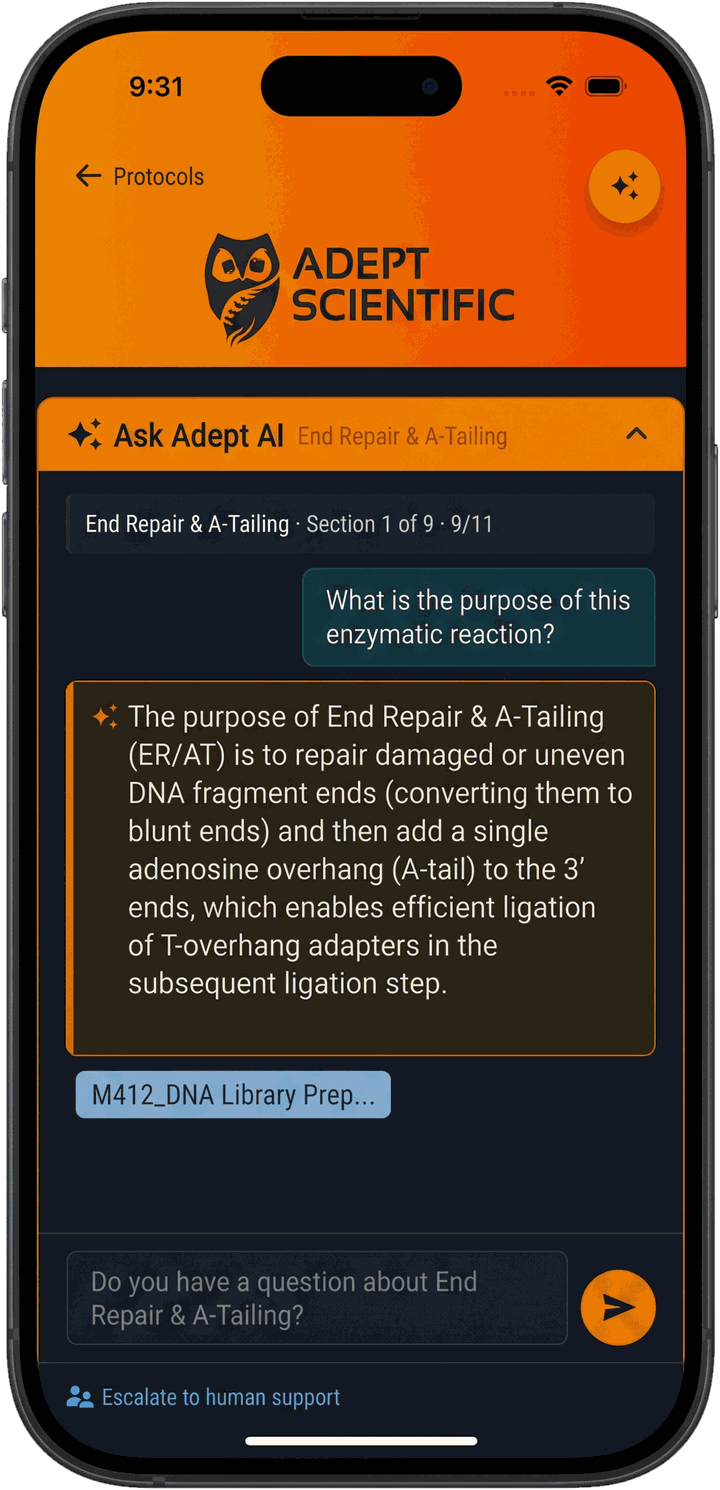
Adept's app guides scientists through your protocols by voice, right at the bench. Their questions get answered before they become tickets, and every run becomes structured data your product, support, and quality teams can act on.
Six manufacturer views, sample data, no form to fill in.
You know units sold and who complained loudly enough to file a ticket. Here's what manufacturers told us they can't see. Hover over a card to see what we heard.
How do you know whether a failed result came from the product or from execution?
"If we assume they did everything perfectly, then yeah, the results are the results. But boy, do we really believe that?"
How do product teams get visibility into what is actually happening at the bench today?
"Product managers don't get reliable data from support tickets."
Why are customers still asking questions that are already answered in the protocol?
"Not a single customer has ever read their user guide start to finish."
How often do customers try your product and disappear without ever asking for help?
"We're sending out free samples and it's like, 'Have you tested it?'"
How many weeks or months are troubleshooting and optimization cycles adding to adoption?
"It could be months or it could be weeks."
How much of your support burden comes from users who are not experts?
"Half our customers are not experts, and those are the ones that require the most extensive support."
One loop from the scientist's bench to your product team, and back again.
Replace paper manuals with expert help in the moment it's needed.
In the Adept app, on a phone, tablet, or any browser, voice guidance walks scientists through your protocol step by step. An AI support agent grounded in your approved product content gives precise answers around the clock, with the source cited, and hands off the conversations that need a person. Every guided run is captured as it happens: timing per step, pauses, deviations, and the questions scientists ask ("Why is this cloudy?").
Field data from your deployment is aggregated and anonymized into interactive dashboards. Spot step-level bottlenecks, track lot-to-lot variance, and catch early-warning signs on accounts that are quietly struggling.
Stop guessing what goes wrong after the kit leaves your warehouse. Use hard telemetry to update user guides, deploy targeted field alerts, and resolve support tickets faster.
In practice: a single flagged reagent lot shows up automatically in both Support's ticket queue and Quality's watchlist. The same signal, seen by both teams, without anyone connecting the dots by hand.
One health score, combining success rate, deviations, and query volume, flags which accounts need a call today.
A ranked triage queue traces this week's ticket spike straight to the lot causing it.
A step-by-step confusion heatmap shows exactly which page to fix next in the user guide.
Lot-level success rates flag a failing lot for quarantine before it becomes a complaint.
Adoption curves show which assay is taking off months before published research confirms it.
Sample data, no form to fill in.
View them nowAnd back to Guide. Update your guidance once and every customer sees the latest version instantly. Your kit can stay fixed under change control; what you know about it, and how you guide people through it, keeps getting better.
Support costs scale with every product you ship.
Start from our conservative assumptions and adjust them to match your portfolio. Every number below updates as you move the sliders.
We default low. Move it up if your ticket mix is mostly repeat protocol questions.
Estimates only, based on the figures you enter. Savings are support costs avoided when questions are answered at the bench instead of reaching your team, before the cost of your Adept engagement, which is scoped to the product families you deploy on. Your actual savings depend on your ticket mix, your support cost structure, and deployment scope. Talk to us for a tailored analysis that includes your engagement cost.
The calculator measures what you stop spending. This is what you start knowing. Every guided run produces a protocol execution record, showing step by step how a scientist ran your protocol. Those records show you what to fix next, which accounts are at risk, and whether your last change worked. No survey, ticket queue, or field visit can tell you that.
"Customers are reporting low yield with this kit."
That step 7 is where users stall, that the median dwell time there is three times your documented estimate, and that the failure concentrates in first-time users rather than in a reagent lot.
"Our protocol success rate looks acceptable."
Acceptable compared to what. Your own SKUs against each other, this lot against the last twelve, experienced labs against first-time users, this quarter against the one before the revision shipped.
Nothing. The account simply stops reordering.
That their last four runs failed at the same step and that nobody opened a ticket. Silent churn becomes a signal you can act on months before the renewal conversation.
The risk in bundling software with your kit is not whether it works. It is whether scientists use it. Here is what bench scientists told us after running their own protocols with Adept.
"It is like having a lab notebook without having to write and type one, and I very much like that."
"I love the ghost of the previous and future step display, giving a reminder of what was just done and what to look forward to."
"I particularly love the fact that it does the calculations for me."
"Adept offers a solution that cuts the planning time in the lab substantially. For a new kit, or even a kit I've been using, interacting with the protocol and creating documentation in real time changes the game."
"I think having an AI trained to the level of a senior scientist on a specific workflow and its underlying molecular biology would be a real asset, a force multiplier, for a team, assisting a technician or research assistant every time they run the workflow on a plate of samples."
"I've spent the last 15 years managing teams and executing complex NGS protocols on large cohorts of samples myself. I've had numerous moments where a tech would have to leave the lab, come find me, and ask a question that pauses the whole workflow."
"I loved trying out the app; it was nice that it was self-paced. I think I would use this every time or close to it, especially for a more complicated procedure."
Every engagement runs on the same standard terms. No pooling, no sharing, no exceptions negotiated case by case.
Start with a 4-week evaluation. From there, each engagement is an annual agreement sized to the product families you put on Adept. The difference between them is scale, depth of data, and how closely our team works alongside yours.
A short, defined test on live runs, so the results make the decision instead of a sales pitch.
For rolling out on the product line with the heaviest support load, after a successful evaluation.
For expanding across your portfolio once the first family proves out.
For large manufacturers with many product lines and their own IT, security, and support requirements.
From a 4-week evaluation to a portfolio-wide agreement, your deployment is isolated from every other manufacturer's, nothing from it is used for model training or industry benchmarking, and your documentation is returned or deleted at contract end. Scientists' run records belong to them, so your dashboards show execution data aggregated and anonymized, never their results, sample identities, or project context. Read how data is handled.
Scientists never pay to use Adept, so nothing stands between your kit and the assistant. That is what drives the adoption behind every number on this page. See what scientists get.
Everything a commercial or product leader wants to know before working with Adept.
Your protocol is added to the Adept app, where scientists get step-by-step, voice-guided instructions for it alongside the other protocols they run. There is no re-engineering of your kit or instrument required. A branded version of the assistant is available for deployments, scoped with your team.
Scientists' run records belong to them. Your dashboard shows execution data aggregated and anonymized to protect individual user identity, and never their results, sample identities, or project context. Each deployment gets a strongly isolated, siloed knowledge base and analytics that are never shared across customers, encrypted in transit and at rest, with role-based access and MFA for privileged users. Customer and scientist data is not retained by third-party model providers and is not used to train third-party models. Transcripts and usage stats are used only to deliver and improve your own deployment, never for model training or industry benchmarking. At contract end, your documentation is returned or deleted, and data governance is worked out before any agreement is signed. Full detail on our security page.
Field application scientist teams provide expert support but do not scale and capture little structured data. Generic support platforms handle tickets, not multi-step protocol execution. Adept guides the protocol itself, in real time, and turns every run into structured, SKU-level intelligence, which is something neither approach produces today. Want to equip your own field team instead? See Beacon.
Most manufacturers start with a 4-week evaluation on a single flagship product family, with success criteria agreed before kickoff. There is no engineering lift required on your side. If the results meet the criteria, the evaluation rolls into an annual deployment.
Pricing is structured per product family, so you only pay for the SKUs where support burden is highest. Most manufacturers start with one flagship family and add more as the value proves out; see the ways to engage above. Use the calculator above to estimate your savings, then talk to us for a quote tailored to your portfolio.
Adept is built for manufacturers selling complex, workflow-intensive products, including NGS reagent kits, analytical instruments, and liquid handling automation, where protocol execution is high-stakes and support burden is acute. Installing and onboarding instruments with your field team? See Beacon.
Adept is led by Kristina Fontanez, PhD, a repeat founder who co-invented the single-cell technology powering Illumina’s Billion Cell Atlas. She previously co-founded Fluent BioSciences, acquired by Illumina for $85M in 2024.
After 12+ years building molecular tools, she's now solving the real-time support bottleneck for genomics and life science products at scale.
She's building Adept alongside Drew Bryant, PhD (Head of Software Engineering, ex-Google, ex-Amazon) and Jason Callina (CTO, ex-Woebot Health), bringing 30+ years of combined experience shipping production software and scientific AI/ML.
Join the manufacturers using real-world execution data to ship better products, faster.
Want to see the data model first? Explore the live dashboards, no form required.